
Craig rang me last March, week into the wet season, properly stressed. His Rocklea warehouse…
Full Broadcast vs Partial Flake Epoxy: Which Coverage Is Right for Your Brisbane Floor?
In this guide:
- What Is the Difference Between Full Broadcast and Partial Flake Epoxy?
- Understanding Flake Coverage Percentages and Visual Impact
- Cost Differences Between Coverage Options
- Performance Benefits of Full Broadcast Systems
- When Partial Coverage Makes Sense for Your Space
- Visual Comparison: Light, Medium, and Full Broadcast Examples
- Choosing Coverage Based on Traffic and Usage Requirements
Most Brisbane homeowners pick a flake coverage level based on what looks good in a photo. But coverage percentage affects more than just appearance — it changes how your floor performs, how easy it is to clean, and what you’ll pay. Getting it wrong means either overspending on a look you didn’t need, or underspending on a floor that won’t hold up.
Full broadcast and partial flake epoxy are both popular choices in Brisbane — but they suit different spaces, budgets, and performance requirements. A garage used daily by a tradie has very different needs to a residential entertaining area or a retail shopfront.
In this guide, you’ll learn exactly what separates the two systems, how each performs in Queensland’s climate, what the real cost difference looks like, and how to match coverage level to your space.
What Is the Difference Between Full Broadcast and Partial Flake Epoxy?
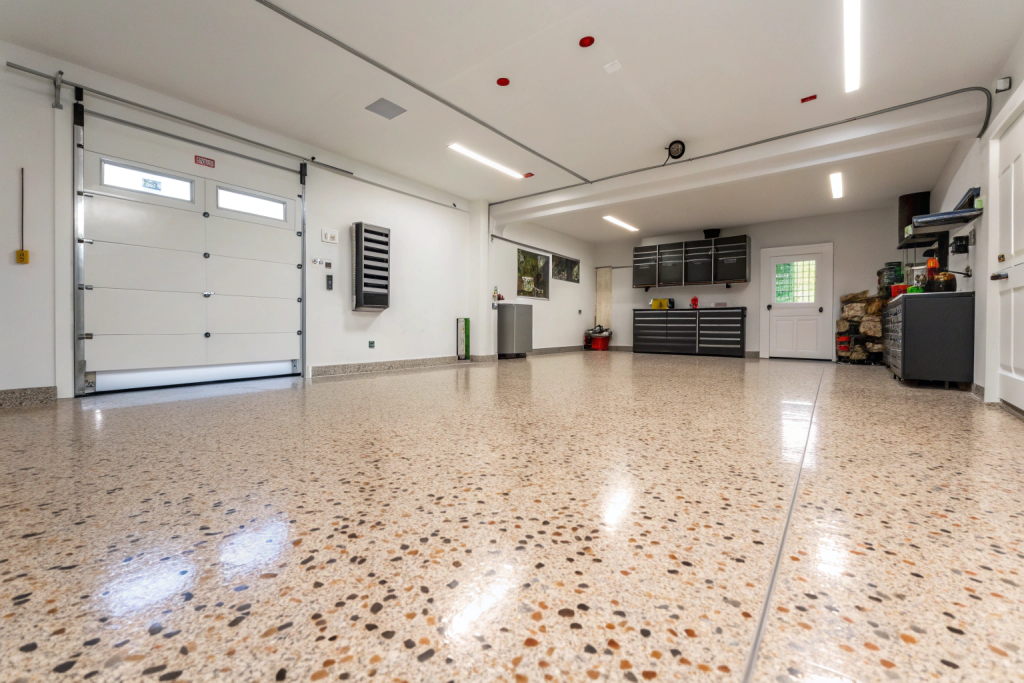
Full broadcast epoxy covers 90–100% of the floor surface with decorative flakes, completely hiding the base coat and creating a highly textured, slip-resistant finish. Partial flake epoxy scatters flakes across 10–50% of the surface, leaving the base coat colour visible for a subtler, speckled look.
Here’s how the two systems compare:
| Feature | Full Broadcast | Partial Flake |
|---|---|---|
| Coverage | 90–100% | 10–50% |
| Appearance | Uniform, textured | Speckled, base coat visible |
| Slip Resistance | Superior | Moderate |
| Durability | Higher | Moderate |
| Best For | Garages, commercial, high-traffic | Residential, decorative, light use |
| Cost | Higher | Lower |
For Brisbane properties exposed to humidity, heavy foot traffic, or vehicle use, full broadcast systems offer better long-term performance. Partial flake suits spaces where aesthetics take priority over heavy-duty durability.
To understand why those differences matter, it helps to start with what coverage percentage actually means — and how it changes what you see on the finished floor.
Understanding Flake Coverage Percentages and Visual Impact
Coverage percentage sounds technical, but it’s simple once you see how it breaks down. Here’s what the numbers mean in practice — and why they matter more than most people realise before they commit to a finish.
What Coverage Percentage Actually Means
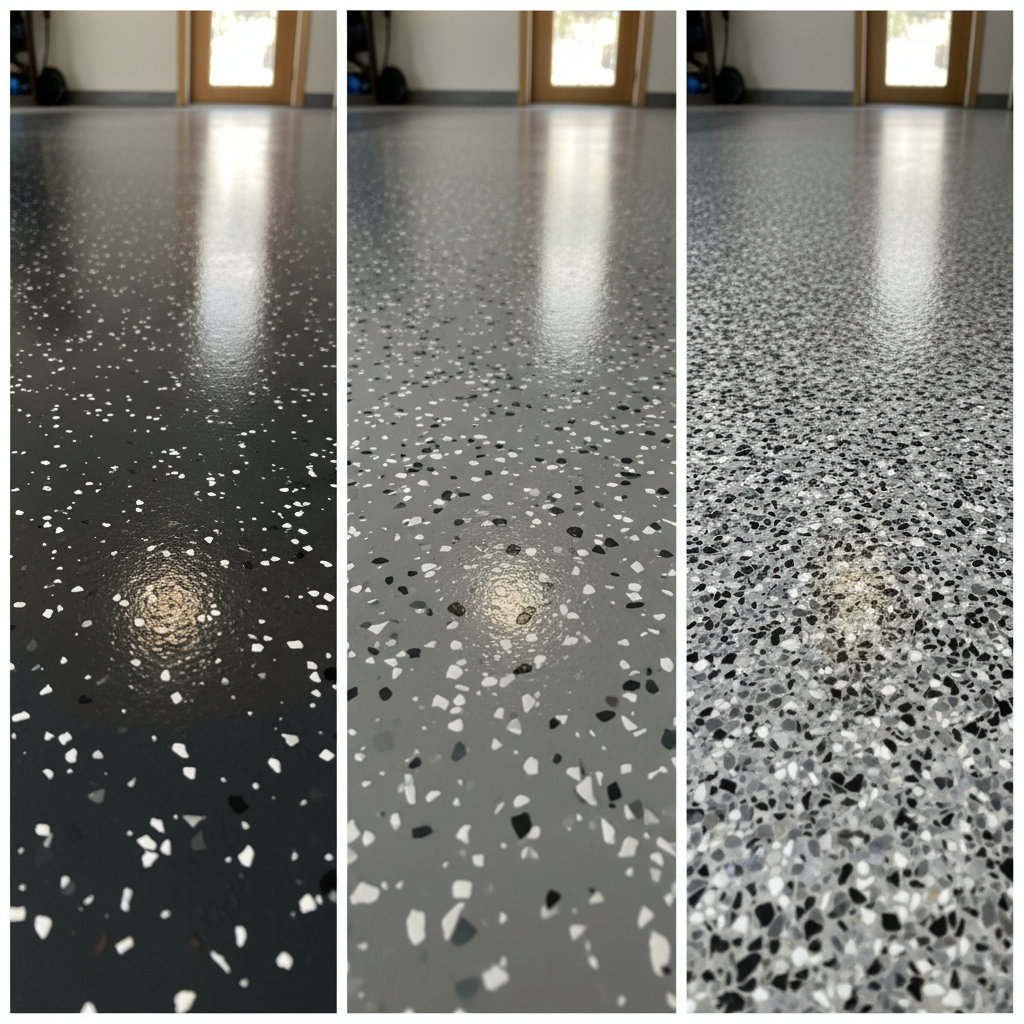
The coverage spectrum runs from light scatter (10–30%), through medium (40–60%), up to full broadcast (90–100%). The percentage is determined during installation by the volume of flakes broadcast per square metre while the epoxy is still wet. It’s not guesswork — an experienced installer controls this precisely. And “partial” isn’t one look — a 15% scatter and a 55% scatter are both technically partial, but they look completely different on the finished floor.
How Coverage Affects the Final Appearance
Full broadcast produces a uniform, tile-like texture with no base coat visible. Medium partial creates a speckled effect where the base coat colour plays a supporting visual role. Light scatter lets the base coat dominate, with flakes as accent only. This is why base coat colour becomes a critical decision for any partial system — it’s not background, it’s part of the finished look.
Once you understand how coverage affects appearance, the next question most Brisbane homeowners ask is: what does it cost?
Cost Differences Between Coverage Options
Coverage level is one of the biggest cost levers in any epoxy job. Here’s what drives the price difference — and what you actually get for the extra spend.
| Cost Factor | Full Broadcast | Medium Partial | Light Scatter |
|---|---|---|---|
| Flake material volume | High | Medium | Low |
| Labour time | Longer | Moderate | Shorter |
| Topcoat consumption | Higher | Moderate | Lower |
| Typical price premium vs light scatter | +25–40% | +10–20% | Baseline |
| Long-term value (lifespan) | Highest | Moderate | Lower |
Full broadcast costs more upfront, but the longer lifespan closes that gap faster than most people expect.
Brisbane tip: Always request a quote that specifies coverage percentage — not just “partial” or “full.” It’s the only way to compare installers accurately.
Price is one part of the equation — but for high-use spaces, performance is where full broadcast systems really separate themselves.
Performance Benefits of Full Broadcast Systems
Full broadcast isn’t just a visual choice — it’s a performance upgrade. Here’s why high-traffic and commercial spaces in Brisbane consistently specify it.
- Slip resistance: Dense flake layer creates texture that exceeds AS/NZS 4586 requirements for wet areas — important for Brisbane’s humid conditions and summer storm season
- Impact and abrasion resistance: The full flake layer acts as a sacrificial wear surface, protecting the base epoxy underneath
- Crack and imperfection concealment: 100% coverage hides surface blemishes, repaired cracks, and uneven concrete colour — no base coat to reveal substrate issues
- Chemical resistance: More flake density means less direct exposure of the base coat to spills, oils, and cleaning agents
- Easier long-term maintenance: Uniform texture means dirt and grime don’t settle against visible base coat
- UV performance: Full coverage slows colour fade in areas with indirect sunlight — a real factor in Queensland conditions
A retail shopfront in Paddington upgraded from medium partial to full broadcast after the base coat began showing wear lines within 12 months. After switching to full broadcast, the floor held up cleanly through high daily foot traffic with no visible wear at the 12-month mark. For commercial spaces, WorkSafe Queensland provides guidance on minimum slip resistance requirements for workplace floors.
That said, full broadcast isn’t always the right call. Here’s when partial coverage is genuinely the smarter choice.
When Partial Coverage Makes Sense for Your Space
Partial flake isn’t a compromise — in the right space, it’s the smarter choice. These are the situations where it genuinely outperforms full broadcast.
Residential Spaces With Decorative Priority
In living areas, home offices, or bedrooms, aesthetics lead the decision. The base coat colour becomes part of the design rather than something to hide — giving you more customisation flexibility. Lower foot traffic means the durability gap between systems is far less relevant.
Spaces Where Texture Is a Drawback
Barefoot areas can feel uncomfortable with a dense flake layer. Spaces needing smooth, easy-sweep surfaces — like home workshops with fine dust — suit lighter coverage. Show garages and display spaces often prefer the sleeker finish partial systems deliver.
Budget-Constrained Projects
Partial coverage reduces material and labour costs without sacrificing a quality install. For investment properties or pre-sale renovations, it’s a valid approach — though we’d recommend medium partial (40–60%) as a minimum for any area with regular foot traffic.
A homeowner in Bulimba chose a 50% partial system in charcoal base coat for their entertaining area — clean, modern finish without the cost or texture of full broadcast.
Sometimes the easiest way to decide is simply to see the difference side by side.
Visual Comparison: Light, Medium, and Full Broadcast Examples
Seeing the difference side by side makes the decision a lot clearer. The three examples below show how dramatically coverage percentage changes the finished result — even on the same base coat colour.
Light Scatter — 20% Coverage
- Best suited for: Decorative residential rooms, low-traffic areas
- Base coat visibility: High
- Texture level: Low
- Flakes sit as accent details against a dominant base coat colour
Medium Partial — 50% Coverage
- Best suited for: Entertaining areas, home offices, investment properties
- Base coat visibility: Moderate
- Texture level: Medium
- Base coat and flakes share equal visual weight for a balanced finish
Full Broadcast — 100% Coverage
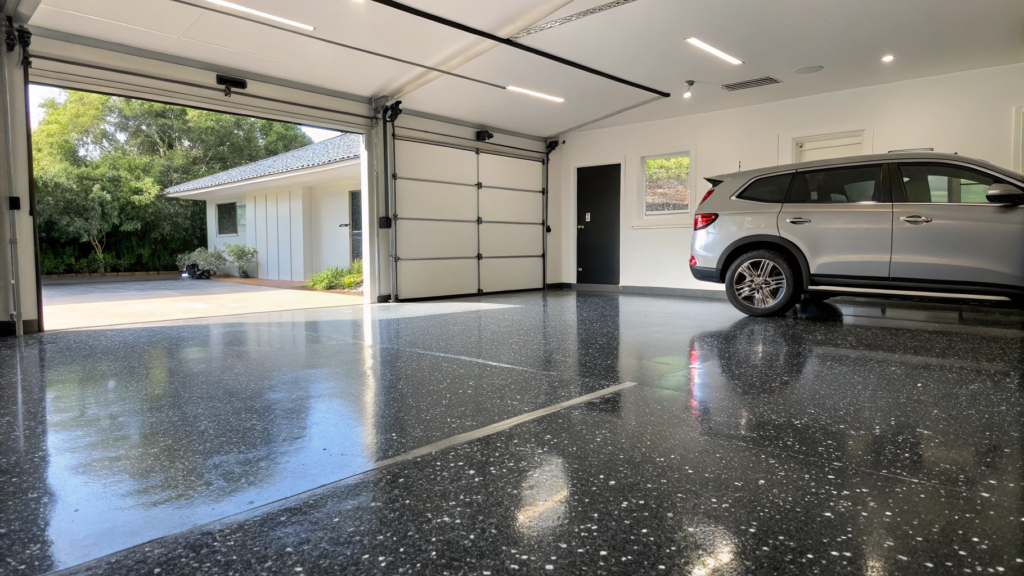
- Best suited for: Garages, commercial floors, wet areas, high-traffic spaces
- Base coat visibility: None
- Texture level: High
- Dense, uniform finish with no base coat visible — built for performance
Now that you can see the visual difference, here’s how to match coverage level to your specific space and usage.
Choosing Coverage Based on Traffic and Usage Requirements
The clearest way to match coverage level to your space is to work backwards from how the floor will actually be used.
| Space Type | Traffic Level | Recommended Coverage | Reason |
|---|---|---|---|
| Residential garage (daily driver) | Medium–High | Full broadcast 90–100% | Vehicle traffic, oil, abrasion |
| Home entertaining area | Low–Medium | Medium partial 40–60% | Aesthetics + light foot traffic |
| Retail shopfront | High | Full broadcast 90–100% | Continuous foot traffic, cleaning frequency |
| Home office or bedroom | Low | Light scatter 10–30% | Decorative priority, minimal wear |
| Commercial warehouse | Very High | Full broadcast 100% | Heavy loads, forklifts, chemical exposure |
| Investment property | Low–Medium | Medium partial 40–60% | Cost efficiency, broad appeal |
| Pool surrounds / wet areas | Medium | Full broadcast 90–100% | Slip resistance critical per AS/NZS 4586 |
- When in doubt, go one level higher than you think you need — coverage is harder to add after installation than to plan for upfront
- Ask your Brisbane installer to show completed examples of each coverage level in similar spaces
- Get quotes that specify coverage percentage — not just “partial” or “full” — to compare accurately
Not Sure Which Coverage Is Right for Your Floor?
Tell us about your space and we’ll recommend the right coverage level — no obligation, no sales pressure.
At Epoxy Flooring Masters South Brisbane, we work with homeowners and businesses across Brisbane every day to match the right system to the right space. Whether you’re coating a garage, a retail shopfront, or a residential entertaining area, we’ll walk you through your options and give you a straight answer.
Here’s how it works:
- Submit your enquiry or call us directly
- We’ll ask a few quick questions about your space and usage
- You’ll receive a coverage recommendation and obligation-free quote within 24 hours
We respond to all enquiries within 1 business day.
Call us: 0748000057
