
A forklift drops a pallet from chest height. A chemical drum springs a slow leak…
How Warehouse Epoxy Flooring Performs in Brisbane’s Climate: A 2026 Performance Guide
Craig rang me last March, week into the wet season, properly stressed. His Rocklea warehouse floor had started bubbling near the loading docks — paint lifting in patches, forklifts leaving tyre marks where the coating had gone soft. Floor was barely three years old. “Mate, what’s going on?” he asked. Simple answer — wrong epoxy system, wrong climate.
Brisbane’s subtropical weather puts industrial floors through one of the toughest performance tests in the country. Between 80% summer humidity, savage UV from the Queensland sun, monsoon downpours that flood loading bays, and temperature swings hitting 25 degrees in an afternoon, your warehouse floor copes with a lot. Modern epoxy systems are built to handle exactly these conditions when specified properly for the epoxy flooring Brisbane climate factor.
This 2026 guide walks you through how warehouse epoxy floors actually hold up in our weather — humidity management, UV stability, thermal cycling, wet season resilience, the lot. You’ll see what specs matter, what Australian standards apply, and how to make Queensland’s tough conditions a non-issue for your facility.
How Do Epoxy Floors Perform in Brisbane’s Climate?
Warehouse epoxy floors perform exceptionally well in Brisbane’s subtropical climate when correctly specified and installed. Modern industrial epoxy systems are engineered to handle the region’s specific climate challenges through:
- Humidity resistance — moisture-tolerant primers handle Brisbane’s 70–80% average humidity
- UV stability — aliphatic polyurethane topcoats prevent yellowing from intense Queensland sun
- Thermal cycling tolerance — flexible formulations absorb expansion across 15–40°C swings
- Wet season durability — non-porous surfaces resist water ingress during monsoon rainfall
- Slip resistance — AS4586-compliant aggregates maintain safety on wet floors
- Chemical resistance — protects against industrial spills and cleaning agents
Properly installed warehouse epoxy floors in Brisbane typically last 15–25 years with minimal maintenance, making them the preferred industrial flooring choice for Queensland facilities.
Brisbane’s Humidity Impact on Warehouse Flooring
Brisbane’s average annual humidity sits between 65 and 80%, peaking through the summer wet season according to Bureau of Meteorology climate data. For warehouse floors, that’s not just an uncomfortable number on a thermometer — it’s a constant battle happening underneath your coating.
Here’s what most facility managers don’t realise — concrete slabs aren’t solid barriers. Moisture moves up through the slab from the ground below in a process called moisture vapour transmission, or MVT. In Brisbane’s humidity, that vapour pressure builds up against any coating sitting on top. Standard epoxy systems, the cheap ones, simply can’t cope. The result is osmotic blistering — those bubbles Craig saw at his Rocklea warehouse — and full adhesion failure where the coating just lifts off the substrate.
The fix is in the priming stage. Moisture-tolerant primers and proper vapour barrier systems are what separate a 20-year floor from a 3-year disaster.
Moisture Vapour Transmission Testing Before Installation
Any reputable installer will test your slab before quoting. Calcium chloride testing and relative humidity probe testing both measure how much moisture is moving through the concrete. Brisbane slabs frequently exceed standard tolerance limits, especially in older industrial estates where vapour barriers underneath the slab have degraded.
Moisture-Tolerant Primer Systems for Brisbane Conditions
Epoxy primers engineered for high-MVT conditions can handle moisture readings well above what standard systems accept. These primers chemically bond to damp concrete and create the foundation every climate-engineered warehouse floor needs.
Temperature Cycling: Loading Docks to Cold Storage
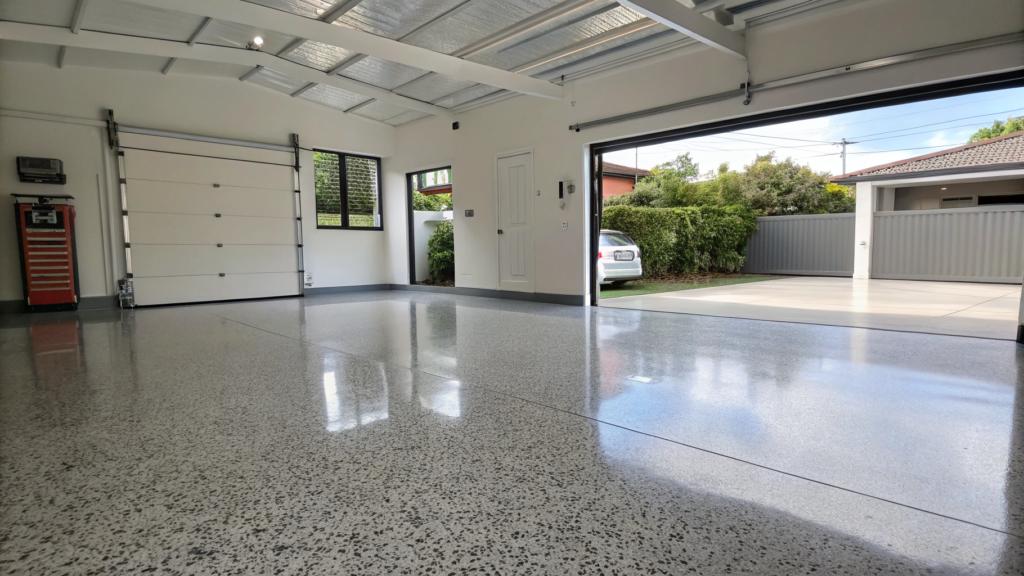
Brisbane temperatures swing from winter lows around 15°C to summer highs north of 40°C, and that’s just the ambient reading. Inside a warehouse, you’re often dealing with bigger differentials — loading dock surfaces baking under summer sun while the cold storage zone twenty metres away sits at minus 18.
That kind of thermal shock is brutal on flooring systems. Concrete expands and contracts as it warms and cools, and coatings that can’t move with the substrate crack, delaminate, or shear off at the bond line. Flexible epoxy formulations are the answer — chemistries engineered with elastomeric properties that absorb thermal movement instead of fighting against it.
Cold Storage and Freezer Zone Specifications
Cold storage zones need specific epoxy systems rated for sub-zero operation. Standard industrial epoxies become brittle below 5°C and fail under impact from forklifts and pallet movement. Polyaspartic and modified urethane systems handle these temperatures without cracking.
Loading Dock Heat Tolerance Solutions
Loading docks see direct sun exposure and surface temperatures that can hit 60°C on concrete during summer. Heat-stable epoxy formulations resist softening, and aliphatic topcoats prevent the chalking that turns dock surfaces grey and crumbly within a few seasons.
Wet Season Challenges for Industrial Flooring
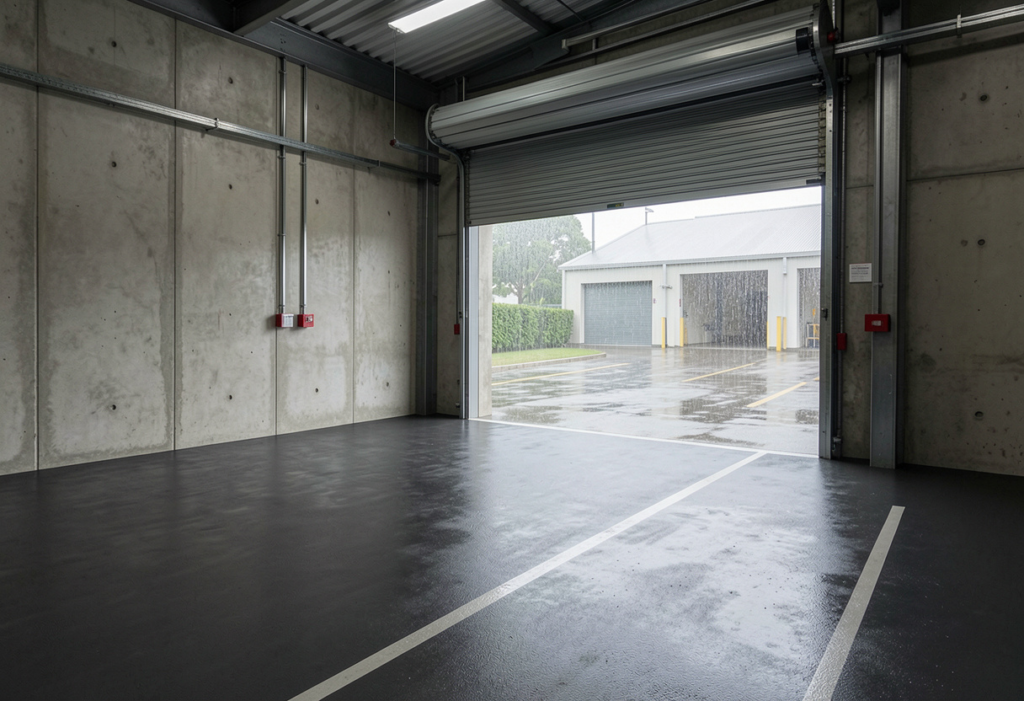
Brisbane’s wet season runs November through April, and the monsoon rainfall during those months puts industrial flooring through hell. Water tracks into facilities at every entry point — roller doors, loading bays, external transitions, even pedestrian doors. Polished concrete absorbs it. Standard sealers swell and peel. Properly specified epoxy doesn’t.
The non-porous nature of cured epoxy is the key. Water sits on the surface, gets squeegeed off, and the floor underneath stays bone dry. No moisture migration into the slab, no efflorescence staining, no slow degradation of the substrate. Compliance with AS4586 slip resistance ratings becomes the next concern once you’ve solved the water ingress side, because a sealed surface that becomes a skating rink isn’t a solution — it’s a lawsuit waiting to happen.
Coving and Drainage Integration
Epoxy coving along wall-to-floor junctions stops water tracking under skirting and rotting timber framing. Integrated drainage falls built into the epoxy screed direct water toward floor wastes instead of pooling.
Wet Floor Slip Safety Compliance (AS4586)
WorkSafe Queensland requirements under the WHS Act 2011 mean slip-rated surfaces aren’t optional in wet-process warehouses. Aluminium oxide aggregates broadcast into the topcoat deliver R10 to R13 slip ratings while keeping the floor cleanable.
UV Stability in Brisbane’s Intense Sunlight
Brisbane’s UV index regularly hits 11 and above during summer, which sits in the extreme category according to ARPANSA UV Index measurements. That UV radiation isn’t just a sunburn risk for your workers — it’s a chemical attack on standard epoxy systems.
Aromatic epoxy resins yellow, chalk, and break down under UV exposure. You’ve seen it in older warehouses — that mustard-coloured tinge near skylights, the powdery surface where roller doors stay open all day, the patchy fade pattern wherever sunlight tracks across the floor. The performance specification matters here. Aliphatic polyurethane topcoats are the industry answer for UV-exposed industrial zones.
Aliphatic Polyurethane Topcoat Systems
Aliphatic polyurethane chemistry stays colour-stable under prolonged UV exposure. The molecular structure resists photochemical breakdown, which means the floor that goes down silver-grey on day one looks the same five years later.
UV-Exposed Zones in Industrial Facilities
Skylit zones, open loading bays, roller door entries, and any area within a few metres of large windows all need UV-stable topcoats. Mapping these zones during the spec phase prevents the patchy ageing that makes a warehouse floor look ten years older than it is.
Thermal Expansion Solutions for Large Warehouses
Concrete slabs in subtropical climates don’t sit still. They expand and contract with temperature and moisture changes, and the bigger the slab, the more total movement you’re dealing with. Large-format warehouses over 1,000 square metres need engineered expansion joints to manage that movement, otherwise the slab cracks where it wants to crack — usually right across your traffic lanes.
Movement allowance under Standards Australia AS3600 concrete standards specifies expansion joint requirements based on slab dimensions and exposure conditions. Get the joint engineering right and the floor moves predictably. Get it wrong and no epoxy system, no matter how flexible, will save you from cracking.
Expansion Joint Design and Integration
Flexible joint sealants — typically polyurethane or polysulphide chemistries — fill the engineered gaps between slab sections and accommodate movement without tearing. Epoxy systems get installed up to the joint edges, never across them.
Large-Format Slab Considerations
Warehouses above 1,500 square metres often need control joints saw-cut into the slab during pour, with movement provisions built into the epoxy system design. Skipping this step is one of the most common reasons large-format industrial floors fail prematurely in Brisbane.
Monsoon Preparation: Moisture Management Systems
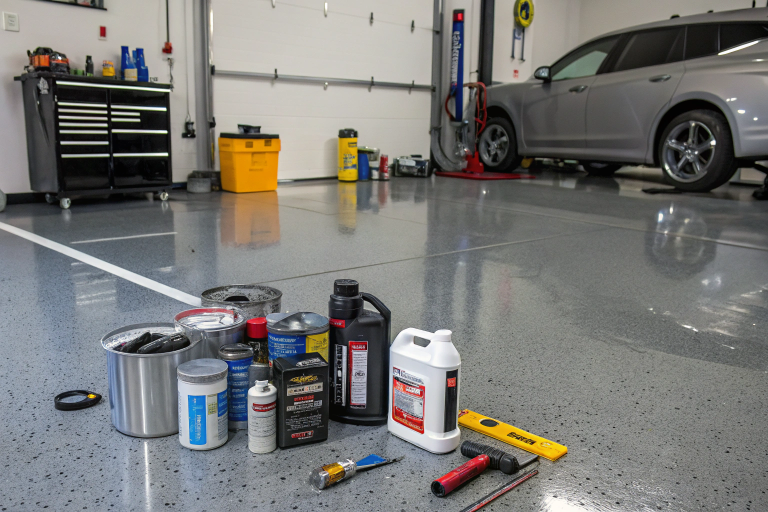
Pre-installation moisture testing is the single most important step in a Brisbane warehouse epoxy job, and it’s where corner-cutting installers cause the most damage. Proper protocols use calcium chloride testing measured in pounds per 1,000 square feet over 24 hours, plus relative humidity probe testing inserted into the slab at specified depths.
Brisbane slabs frequently show high MVT readings, especially in slab-on-ground construction where hydrostatic pressure from groundwater pushes moisture upward year-round. Multi-layer moisture barrier systems — epoxy moisture vapour barrier primer, plus a high-build epoxy intermediate, plus the wear coat — create the resilient stack that handles whatever the wet season throws at it.
Pre-Installation Moisture Testing Protocols
Testing happens before quoting, not after. Any installer who skips moisture testing and offers a flat price is gambling with your investment. Reputable applicators document MVT readings, RH percentages, and surface temperatures, then specify the primer system to match those numbers.
Annual Pre-Monsoon Maintenance Checklist
October is the right month for pre-wet-season inspection in Brisbane. Walk the floor, check joint sealants for tears, inspect coving for cracks, look at high-traffic areas for wear-through, and clean drainage paths so water flows where it’s supposed to. A two-hour annual inspection prevents most of the catastrophic failures that show up after the first big February downpour.
Get Your Brisbane Warehouse Epoxy Specification Right the First Time
Craig’s Rocklea floor failure cost him eleven grand to strip back and redo properly. The original installer saved him about two thousand on the initial quote. That’s the maths on getting epoxy flooring Brisbane climate specifications wrong — every dollar saved upfront costs five down the track.
Epoxy Flooring Masters South Brisbane has been specifying and installing climate-engineered industrial floors across Greater Brisbane for years. Whether you’re running a Rocklea distribution centre, a Logan cold storage facility, a South Brisbane manufacturing plant, or a Redlands logistics warehouse, we’ll walk your site, test your slab, map your climate-exposure zones, and give you a specification that handles whatever Brisbane’s weather throws at it for the next 20 years.
Give us a call or book your free Brisbane warehouse flooring assessment today. We’ll do the moisture testing, climate-zone mapping, and full specification recommendation at no cost — so you know exactly what your facility needs before you spend a cent on installation.

This Post Has 0 Comments