
Craig rang me last March, week into the wet season, properly stressed. His Rocklea warehouse…
Professional vs DIY Epoxy
Professional vs DIY Epoxy in Brisbane: The Complete Homeowner’s Guide
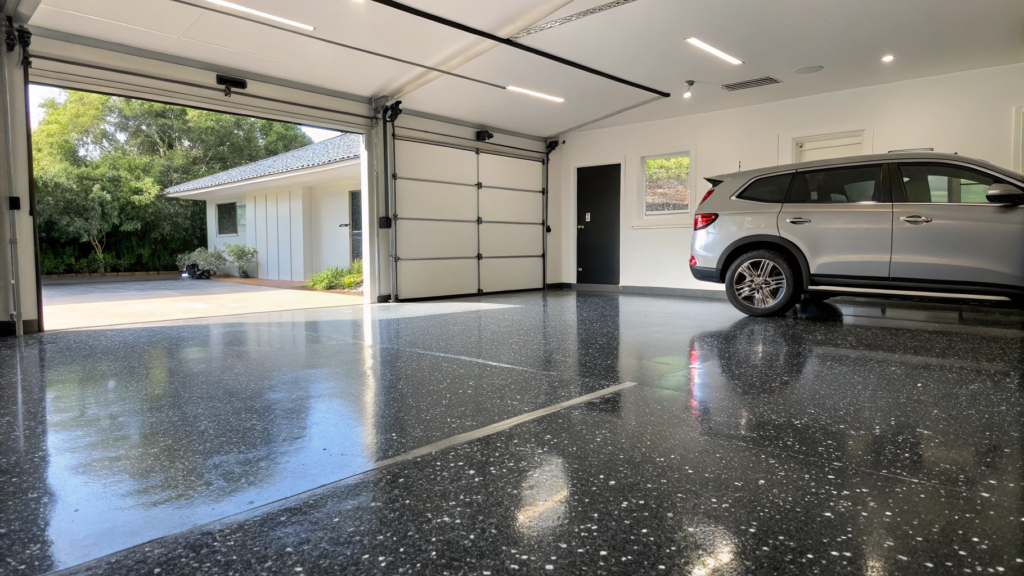
Epoxy flooring is one of the smartest upgrades a Brisbane homeowner can make — durable, low-maintenance, and genuinely impressive to look at. The real question isn’t whether to install it. It’s whether to bring in a professional team or tackle it yourself.
Both paths are worth understanding clearly before you commit. Professional installation delivers a system engineered for Brisbane’s humid subtropical conditions, applied with commercial-grade equipment and backed by a warranty. DIY kits offer a lower upfront price and the appeal of a weekend project — and in the right circumstances, they can work.
This guide gives you an honest, cost-driven comparison across the factors that matter most: long-term value, surface preparation standards, equipment capability, and Brisbane-specific application challenges. By the end, you’ll know exactly which option suits your project, your property, and your budget — and you’ll be equipped to make that call with confidence.
What’s the Difference Between Professional and DIY Epoxy Flooring?
Professional epoxy flooring differs from DIY in five key areas:
- Surface preparation — Professionals use diamond grinding equipment; DIY relies on acid etching, which leaves a moisture-vulnerable surface profile
- Product grade — Commercial systems use 100% solids epoxy; hardware store kits are typically water-based with 40–60% solids content
- Application conditions — Pros monitor humidity and dew point before and during installation; DIY applications in Brisbane’s climate frequently fail due to moisture interference
- Durability — Professional systems typically last 10–15 years; DIY coatings average 2–4 years before peeling or delamination
- Cost over time — A lower DIY upfront cost is often offset by reapplication and remediation expenses within 3–5 years.
Real Cost Analysis: Professional vs DIY Over 10 Years
The upfront price difference between DIY and professional installation looks compelling on paper. A standard DIY kit for a double garage covers materials, but rarely accounts for the full picture — surface preparation chemicals, equipment hire, application tools, and the strong likelihood of reapplication within a few years.
Professional installation for the same space is a single, comprehensive investment. It covers labour, commercial-grade materials, preparation, and a warranty. The gap between the two options narrows significantly once those hidden DIY costs are factored in.
What a DIY project actually costs:
- Kit materials
- Surface preparation chemicals and equipment hire
- Application tools (rollers, squeegees, mixing equipment)
- Reapplication at year 2–4 (labour and materials)
- Remediation if the coating fails (grinding back, disposal, recoat)
What professional installation includes:
- Full surface preparation to industry standard
- Commercial-grade epoxy system specified for your slab and use case
- Warranty coverage on materials and workmanship
- A 10–15 year lifespan with minimal ongoing maintenance
Over a 10-year window, a DIY path that requires even one remediation event frequently exceeds the original cost of professional installation — often without matching the finish quality or durability of the professional result.
The smarter financial calculation isn’t what you spend on day one. It’s what you spend across the life of the floor.
Surface Preparation: Where DIY Projects Fail Most
Surface preparation is where professional and DIY epoxy installations diverge most significantly — and where the majority of DIY failures originate.
Epoxy adhesion depends on achieving a concrete surface profile (CSP) between 2 and 3, as specified in Australian standards for surface-applied coatings. This requires mechanically abrading the concrete surface to create the microscopic texture that allows the epoxy system to bond correctly.
Acid etching vs diamond grinding
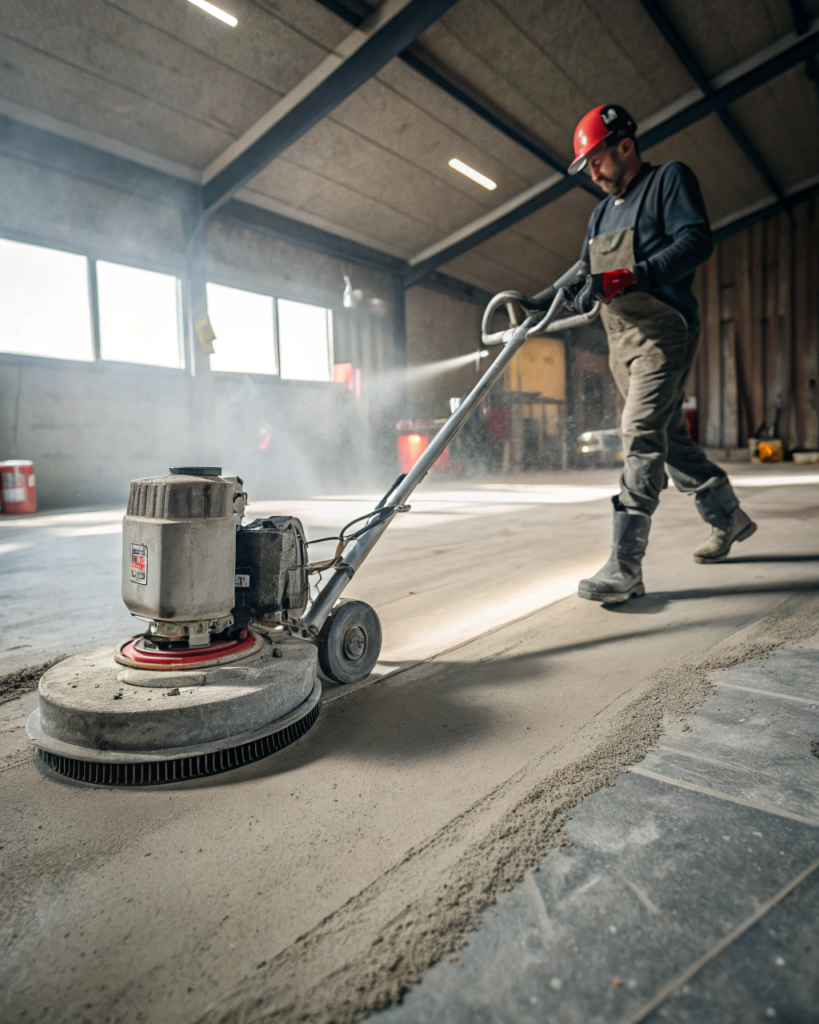
Most DIY kits recommend acid etching as the preparation method. It’s accessible, inexpensive, and easy to apply — but it doesn’t consistently achieve the required surface profile, particularly on denser concrete slabs or surfaces with existing contamination. Diamond grinding, the industry standard used by professional installers, removes laitance and contaminants mechanically and produces a reliable, repeatable profile every time.
Moisture testing in Brisbane’s climate
Before any epoxy application, the slab must be assessed for moisture vapour transmission (MVT). Brisbane’s subtropical conditions mean that moisture in and around the slab is a persistent variable. Professional installers test for MVT as a standard step. DIY applications rarely include this assessment, and moisture contamination is the leading cause of epoxy delamination in Queensland.
When preparation is skipped or inadequate, the epoxy system doesn’t fail immediately — it typically holds for 6–18 months before peeling begins. By that point, remediation costs more than the original professional installation would have.
Professional Equipment vs Hardware Store Tools
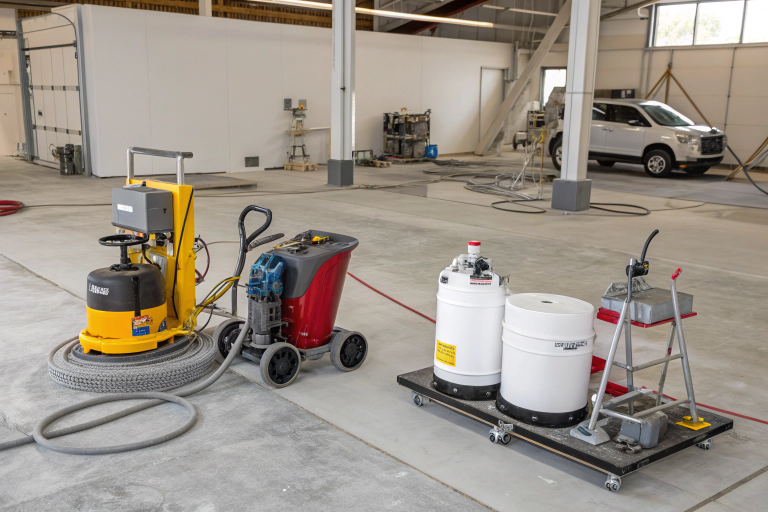
The equipment gap between professional and consumer epoxy application is wider than most homeowners realise, and it has a direct impact on the quality and longevity of the finished floor.
Grinding and surface preparation
Industrial diamond grinders used by professional teams are purpose-built for concrete surface profiling. They produce consistent, calibrated results across large surfaces and remove contamination effectively. Consumer-grade grinders — even hired equipment — lack the weight, cutting capacity, and consistency to match this performance. The result is an uneven surface profile that creates weak adhesion points across the floor.
Application precision
Epoxy systems must be applied at a precise mil thickness to cure correctly and achieve the rated performance. Professional teams use calibrated spread rates and wet film gauges to maintain consistent thickness throughout the pour. Hardware store kit instructions offer general coverage guidance, but without gauging equipment, achieving uniform thickness across an entire garage floor is extremely difficult.
Environmental monitoring
Dew point, ambient humidity, and slab surface temperature all directly affect epoxy cure chemistry. Professional installers carry thermometers, hygrometers, and dew point calculators as standard site equipment. If conditions fall outside acceptable parameters — which happens regularly in Brisbane summers and during the wet season — a professional team reschedules the job. A DIY applicator working on a Saturday morning rarely has access to this information, let alone a plan for acting on it.
The equipment difference isn’t just about finish quality. It’s about whether the floor will still be performing in five years.
Brisbane-Specific Application Challenges
Brisbane’s climate creates a specific set of challenges for epoxy flooring that don’t apply in cooler, drier parts of Australia — and that make local expertise genuinely valuable rather than just commercially convenient.
Humidity and dew point
According to Bureau of Meteorology climate data for Brisbane, the city averages relative humidity of 60–70% year-round, with the wet season (November through April) pushing those figures significantly higher. Epoxy applied in high-humidity conditions can experience surface blush — a whitening or cloudiness caused by moisture interfering with the cure — and reduced adhesion at the bond layer. Professional installers time applications to humidity forecasts and pause work when the dew point approaches the slab temperature. This level of environmental management is rarely part of a DIY workflow.
Slab temperature in Queensland summers
Concrete slab temperatures above 30°C accelerate epoxy pot life — the working window between mixing and application. In Brisbane’s summer months, particularly for north-facing garage slabs, surface temperatures can exceed this threshold by mid-morning. Shortened pot life causes premature gelling, uneven application, and surface texture inconsistencies. Professionals address this by scheduling applications in cooler parts of the day and selecting systems formulated for higher ambient temperatures.
Coastal and bayside properties
Properties in South Brisbane’s bayside fringe, along the Moreton Bay foreshore, and across inner-city areas with higher airborne salt exposure face additional chloride-related challenges. Salt contamination on or within the slab requires specific preparation protocols to prevent coating delamination and long-term substrate degradation. This is a well-understood variable for local professionals — and an invisible one for most DIY applicants.
Common DIY Mistakes and Expensive Fixes
Understanding where DIY epoxy projects go wrong is useful whether you’re evaluating the DIY path or reassessing an existing floor.
Peeling and delamination
The most common DIY failure mode is the most costly to fix. Delamination — where the epoxy coating separates from the substrate — traces almost universally back to inadequate surface preparation or moisture contamination at the time of application. The floor may look good initially. Peeling typically begins between 6 and 18 months post-application, often starting at the edges or in high-traffic areas and spreading from there.
Remediation requires grinding the failed coating back to bare concrete, re-preparing the surface to the correct profile, moisture testing, and re-coating — a full process that frequently costs more than a professional installation would have from the outset.
Bubbling and outgassing
Outgassing occurs when air trapped within the concrete slab escapes through the epoxy coating before it cures. Consumer-grade epoxy products have shorter working windows than professional formulations, making it harder to catch and back-roll bubbles before they set. The result is a pitted surface that looks poor and is difficult to repair without full recoating.
Colour and finish inconsistencies
Achieving a consistent, uniform finish across a large surface requires controlled mixing ratios, consistent spread rates, and experienced application technique. Uneven colour, visible roller marks, and patchy gloss levels are common in first-time DIY applications and are essentially irreversible without starting over.
When DIY Might Work (And When It Won’t)
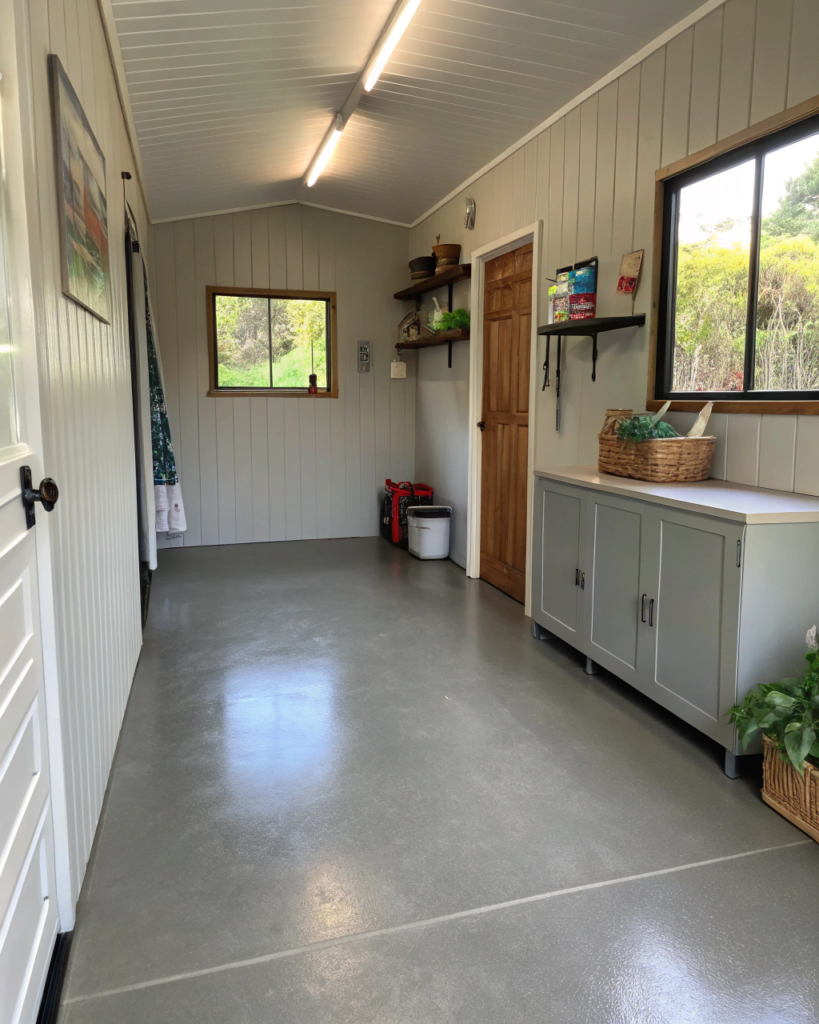
An honest comparison requires acknowledging the scenarios where DIY epoxy is a legitimate, cost-effective choice.
DIY may be appropriate for:
- Low-traffic areas with purely cosmetic requirements
- Surfaces under 20m² in dry, climate-controlled environments
- Applications over existing sound coatings in good condition
- Inland Queensland properties with lower ambient humidity exposure
Professional installation is strongly recommended for:
- Garages, workshops, and any high-traffic residential surface
- Any commercial or industrial space
- Coastal and bayside properties in the Greater Brisbane area
- Slabs with visible moisture issues, cracking, or contamination
- Any application where WorkSafe Queensland compliance documentation is required
- Homeowners who want a single installation that lasts 10+ years
Five questions to ask before you decide:
- Is the slab in good condition, with no visible cracking or moisture staining?
- Is the area under 20m² and low-traffic?
- Are you comfortable with a 2–4 year lifespan and potential reapplication?
- Is your property more than 5km from the coast or Moreton Bay?
- Do you have access to a diamond grinder and environmental monitoring equipment?
If the answer to most of those questions is no, professional installation is the right choice for your property — and the more cost-effective one over time.
Ready to Get It Right the First Time?
A professionally installed epoxy floor from a local South Brisbane team means one installation, a 10–15 year lifespan, and a finish that handles Brisbane’s climate without compromise.
Epoxy Experts South Brisbane services South Brisbane and surrounding areas, including Mansfield, Rochedale, Mount Gravatt, Wishart, and the greater Logan and Redlands corridor.
📍 11 Hugo Pl, Mansfield QLD 4122 📞 07 4800 0057 🌐 epoxyexpertssouthbrisbane.com
Not ready to book yet? Browse our recent South Brisbane project gallery to see what a professional result looks like on floors just like yours — or get in touch to ask any questions before you commit.
