
Craig rang me last March, week into the wet season, properly stressed. His Rocklea warehouse…
Flake Epoxy Floor Maintenance: The Complete Brisbane Homeowner’s Guide
By a QBCC Licensed Epoxy Flooring Specialist, Southeast Queensland
Is Brisbane’s humidity quietly working against your flake epoxy floors — even when they look fine on the surface?
Most homeowners invest in flake epoxy for its durability and low-maintenance appeal. But low maintenance isn’t the same as no maintenance. Queensland’s subtropical climate — high summer humidity, UV exposure, and sudden temperature swings — creates conditions that accelerate wear when the right care routine isn’t in place.
This guide gives you a Brisbane-specific maintenance plan: the cleaning products that hold up in humid conditions, the seasonal checks that protect your investment year-round, and the early warning signs that tell you when it’s time to call a professional.
Here’s what you’ll find:
- Daily and weekly care routines that take minutes, not hours
- The cleaning products to use — and the ones that will damage your floor
- Seasonal maintenance tips tailored to Queensland weather
- How to troubleshoot common flake epoxy problems
- When DIY care is enough — and when it isn’t
What Does Flake Epoxy Floor Maintenance Actually Involve?
Maintaining flake epoxy floors in Brisbane means building a routine adapted to Queensland’s subtropical conditions — not just following generic cleaning advice. Here’s what an effective maintenance plan looks like:
- Daily/weekly: Sweep with a microfibre dust mop or soft-bristle broom to remove grit before it abrades the topcoat
- Spills: Blot immediately with a microfibre cloth — particularly oils, solvents, or anything acidic
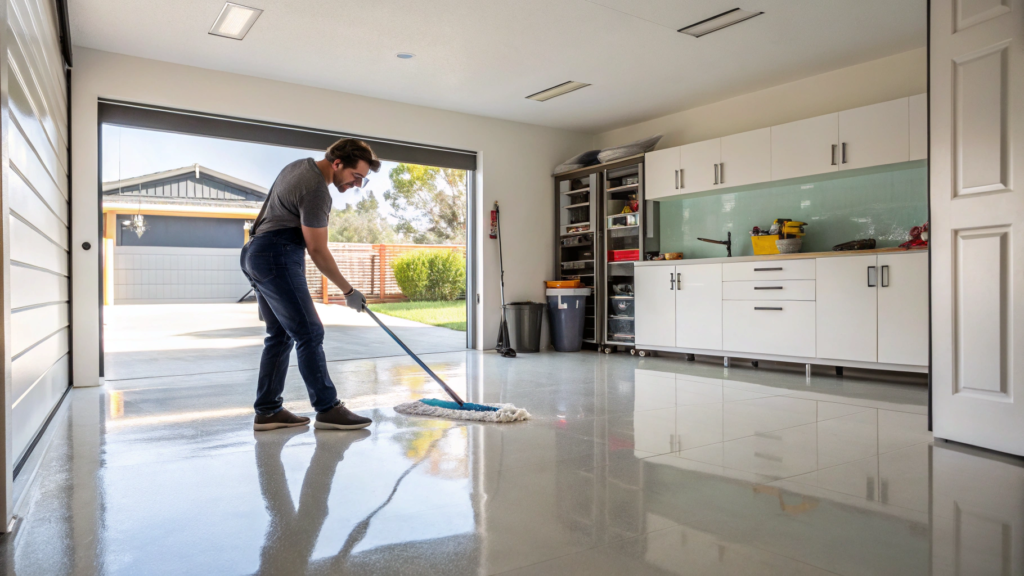
- Monthly mopping: Use warm water with a neutral-pH cleaner; avoid bleach, vinegar, and citrus-based products which degrade the topcoat finish
- Humidity checks: In Brisbane’s wet season, inspect for moisture trapped under edges or near drains
- UV protection: In sun-exposed areas, consider periodic resealing to counter Queensland’s high UV index
- Topcoat recoating: High-traffic floors typically need a fresh clear coat every 3–5 years
Daily and Weekly Flake Epoxy Care Routines
Consistency beats intensity — a 5-minute weekly routine prevents 90% of the premature wear issues we see on Brisbane floors.
The Daily Sweep (When It Matters)
Brisbane homes accumulate grit faster than most people expect — especially in bushland suburbs like Fig Tree Pocket or Pullenvale, or homes with pets. Garage floors used as workshops need daily attention; interior decorative floors can stretch to every 2–3 days. Use a microfibre dust mop over a bristle broom, which grinds particles into the topcoat rather than lifting them.
Weekly Spot Checks
A 2-minute walkover — look for spill residue, grit near entry points, and moisture near garage door seals. Catching a small drip early means a quick blot. Leave it and it becomes a staining job.
Monthly Mop Routine
Use a neutral-pH cleaner with warm water and follow with a rinse pass. In inner Brisbane’s hard water areas, that rinse pass prevents mineral and soap scum buildup.
Getting the routine right is half the equation — the other half is making sure the products you’re using aren’t quietly undoing your efforts.
Best Cleaning Products for Brisbane’s Humid Conditions
Product selection matters more in subtropical climates — humidity means floors stay damp longer after mopping, increasing the window for chemical residue to interact with the topcoat.
| Product Type | Safe to Use | Avoid | Why |
|---|---|---|---|
| Neutral-pH cleaner | ✓ | Preserves topcoat integrity | |
| Bleach-based cleaners | ✗ | Dulls gloss finish over time | |
| Vinegar / citrus | ✗ | Acid degrades epoxy binder | |
| Concrete degreaser | ✓ (diluted) | For grease/tyre marks only | |
| Steam mop | ✗ | Heat stress in humid conditions | |
| Microfibre mop | ✓ | Lifts grit without abrasion |
Most of what you need is available at Bunnings — a quality neutral-pH floor cleaner and a microfibre flat mop covers the majority of routine care. One thing worth knowing: Brisbane’s water hardness varies across suburbs, and in higher-mineral areas residue builds faster, so that rinse pass after mopping isn’t optional.
Product choice stays consistent year-round, but Brisbane’s climate means your maintenance frequency and focus shifts with the seasons.
Seasonal Maintenance Tips for Queensland Weather
Brisbane’s climate doesn’t sit still, and your maintenance routine shouldn’t either.
Wet Season (November–March): This is when flake epoxy maintenance Brisbane homeowners need to take most seriously. Humidity peaks, condensation forms under garage door seals, and tracked-in moisture increases. Check door seals at the start of November, inspect your anti-slip topcoat, and increase mopping frequency. Bureau of Meteorology data shows Brisbane’s average January humidity regularly sits above 70%.
Dry Season (April–October): UV intensity stays high even through winter. North-facing garages are particularly vulnerable to topcoat yellowing. This is the ideal window for resealing or recoating — lower humidity means better product adhesion.
Storm Season Crossover: After heavy storms, clear debris, leaf tannins, and pooled water near garage entries promptly. Tannins can stain flake epoxy if left overnight.
A Paddington homeowner discovered wet season bubbling in year two, traced back to skipped door seal checks the previous November. Edge resealing fixed it — but cost more than prevention would have.
Even with the right routine in place, issues can still emerge — here’s how to identify and address the most common ones before they escalate.
Troubleshooting Common Flake Epoxy Issues
Think of this as your diagnostic tool — what to check when something looks wrong with your floor at 10pm and you’re not sure if it’s serious.
Bubbling or Blistering
- Cause: Moisture vapour transmission through the concrete slab — common in older Brisbane homes with minimal subfloor ventilation
- Trigger: Often appears after wet season or heavy rainfall events
- Fix: Minor blistering can be spot-repaired; widespread bubbling requires professional assessment of the moisture barrier
Topcoat Dulling
- Cause: Acidic cleaners, soap scum buildup, or UV degradation
- Trigger: Gradual — usually noticed after 12–18 months of incorrect product use
- Fix: Professional buff and reseal in most cases; full recoat if degradation is advanced
Flake Loss or Edge Lifting
- Cause: Inadequate surface preparation at installation, or impact damage
- Trigger: High-traffic entry points, garage door thresholds
- Fix: Spot repair is possible but colour-matching is difficult — retain any leftover flake material from your original installation
Staining (Tyre Marks, Oil, Tannins)
- Cause: Prolonged contact with reactive substances
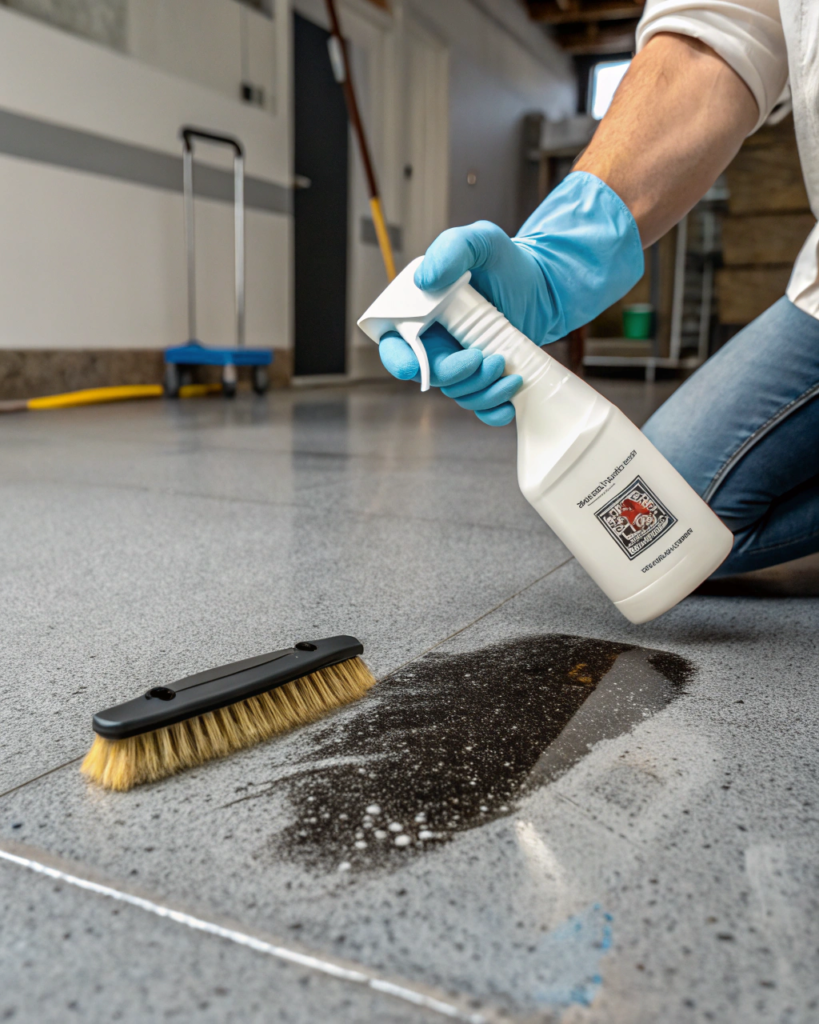
- Fix: Diluted concrete degreaser and a nylon brush; best prevented by prompt blotting
Knowing what’s wrong is useful — knowing whether to fix it yourself or call someone is what protects your investment.
Professional Maintenance vs DIY: When to Call Experts
Most routine maintenance is genuinely DIY-friendly — this section is about recognising the line between homeowner upkeep and work that requires a licensed contractor.
| Situation | DIY Suitable | Call a Professional |
|---|---|---|
| Weekly sweeping and mopping | ✓ | |
| Spot blotting spills | ✓ | |
| Topcoat resealing (minor) | ✓ with correct product | |
| Widespread bubbling or delamination | ✓ | |
| Flake loss across high-traffic zones | ✓ | |
| Full recoat after 3–5 years | ✓ | |
| Moisture barrier failure | ✓ |
In Queensland, always verify your contractor holds a current QBCC licence before engaging anyone for repair or recoat work.
Whether you’re handling maintenance yourself or working with a professional, these techniques will stretch the life of your floor significantly further.
Extending Flake Epoxy Life Through Proper Care Techniques
- Use entrance matting at all garage entry points — Captures grit and moisture before it reaches the epoxy surface. In Brisbane’s wet season, a quality outdoor mat does more protective work than any cleaning product.
- Lift, don’t drag — Moving toolboxes, gym equipment, or furniture across flake epoxy creates micro-scratches that accumulate into visible dulling. Use furniture sliders or carry items the short distance.
- Retain leftover flake material — Ask your installer to leave any remaining flake chips. Colour-matched spot repairs are significantly easier when original batch material is available.
- Schedule a professional inspection every 2 years — A licensed Brisbane contractor can identify topcoat degradation, edge lifting, or moisture issues before they escalate. Combine with a reseal if the floor is in a high-UV or high-traffic area.
- Avoid parking freshly driven vehicles immediately — Hot tyre contact with epoxy topcoat in Brisbane’s summer can cause temporary softening. Allow vehicles to cool before parking where possible.
- Check AS/NZS 4586 slip resistance ratings after resealing — If your floor is in a wet area or pool-adjacent space, confirm the resealed surface still meets Australian Standards slip resistance requirements. A qualified contractor can test this.
Get a Free Epoxy Floor Maintenance Assessment in Brisbane
Staying on top of flake epoxy maintenance doesn’t have to be complicated — but when something flags as a concern, it’s worth getting a professional set of eyes on it early.
At Epoxy Flooring Masters South Brisbane, we carry out free maintenance assessments for Brisbane homeowners across Southeast Queensland. Whether you’ve noticed early signs of topcoat dulling, bubbling near your garage door, or your floor is simply due for a reseal, we can tell you exactly where things stand and what — if anything — needs doing.
Book your free floor assessment today.
Call us on 07 4800 0057 or contact us online to arrange a time that suits you.

This Post Has 0 Comments